

Lent and Easter culinary traditions in Attica
Easter. Spring. Countryside. Flavours with symbolisms and ancient-old traditions. In Greece and Attica, Easter is the greatest holiday of the year, with food playing a starring role. It is deeply connected with culinary traditions that remain vivid and are still practiced today, after all these years.
For Orthodox Christianity, Easter signifies the transition from death to life, and God’s suffering that culminates, followed by the resurrection (and exaltation) of the soul, is depicted on the family table. Families, friends and relatives celebrate the rebirth of nature in the countryside, in the beautiful villages and islands of Attica. Easter in Attica is extraordinary and unique, an experience you should live at least once in your life…
Great Lent and Holy Week fasting
Lent fasting (40 days) begins on Ash Monday and ends on the Friday of the sixth week. It is followed by Lazarus Saturday and Palm Sunday and right after that, the Holy Week begins. For the faithful throughout Attica, it is a period of preparation for the Crucifixion and Resurrection of Christ, during which they abstain from certain food, such as meat, fish, dairy products, olive oil and wine. Nowadays, fasting is only practised during the Holy Week, and it is based on a vegetable, legume and seafood diet.
Good Friday is the day of absolute grief for all Christianity, a day of abstinence from work and food. In the afternoon, after the Deposition of Christ, women and young girls decorate the Epitaph with spring flowers and make wreaths and garlands. The whole day, church bells ring mournfully throughout Attica, and the family table traditionally comprises boiled lentil or bean soup with vinegar, tomato soup, and boiled or raw vegetables, everything without oil. The evening of the same day, the matins of Holy Saturday are recited in churches, followed by the Epitaph procession within the parish, which takes place in great piety. During the procession, the faithful follow the Epitaph with lit candles in their hands, while it is customary for men, women and children to bow down and pass under it, to “receive the grace of Christ”, at the same time indicating obedience to the Lord. In Hydra’s Kamini district, the Epitaph and the whole procession end up at the seafront. Then, the people who hold the Epitaph walk into the water, supporting it in a way that its legs touch the sea, so that it is blessed and sanctified.
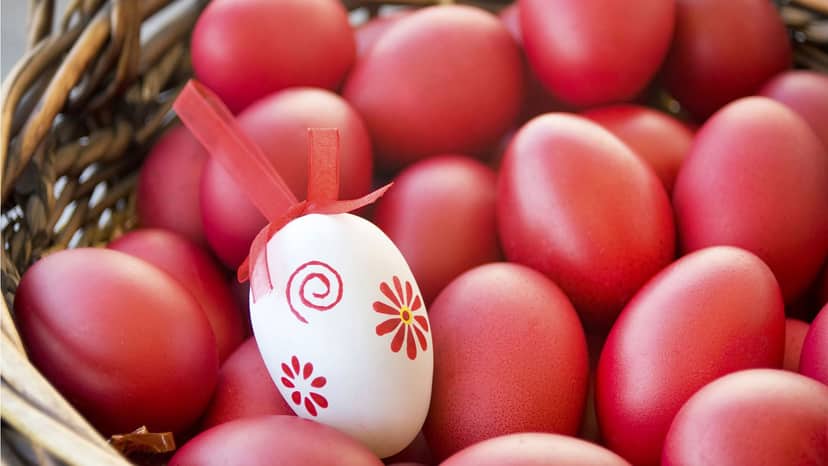
Without a doubt, they are the “trademark” of the Easter table. Traditionally dyed red – variations with bright colours and decorations are also quite common – eggs symbolize life and creation. They are always dyed on Maundy Thursday, the day of the Last Supper. The red colour symbolizes the blood of Christ on the cross, as well as the rebirth of the world and the joy of Resurrection, since the egg is symbolically linked with the tomb of Jesus, which was found empty. With the tapping of the egg, its shell cracks, and a new life is born, just like the tombstone cracked at Resurrection.
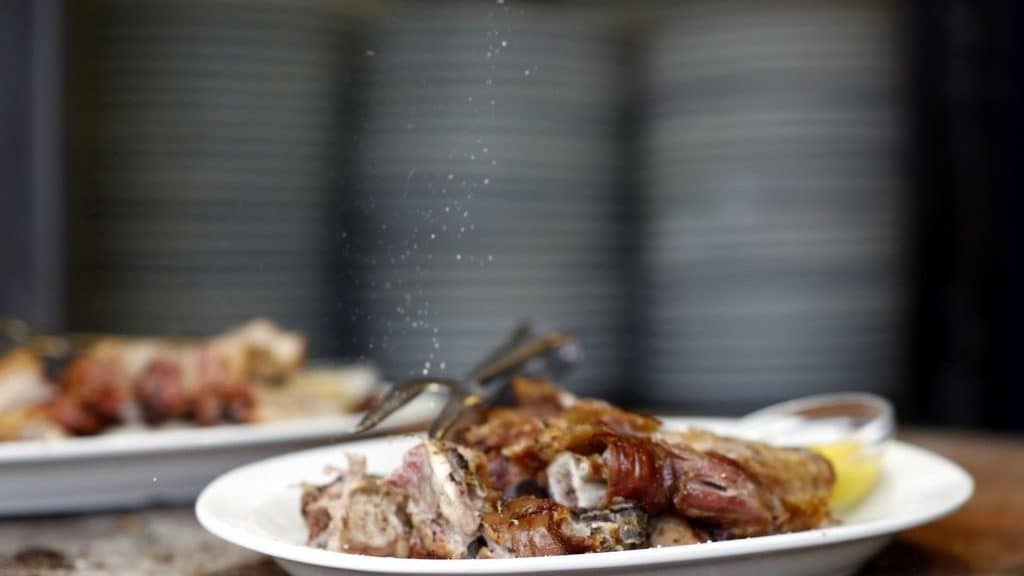
Lamb, kid, and kokoretsi are the stars of the Easter meal, and, interestingly enough, the way they are prepared is traced back to ancient Greece. When ancient Greeks roasted meat on the spit, they dipped a pine twig into a juice of unripe grapes and plums, with which they basted the meat, giving it an aromatic flavour of fruit and resin. Nowadays, the meat is basted with olive oil and lemon juice. To prepare the kokoretsi (goat’s organs and offals in a long skewer, wrapped with intestines), ancient Greeks used to marinade the intestines in vinegar, water, and honey. The vinegar acted as antiseptic and dehydrated the intestines, ridding them of the extra fat, while the honey created a caramelized coating.
The lamb symbolizes the sacrifice of Jesus, who as a “Lamb of God” took on the sins of the world. The Easter Sunday tradition of lamb roasting on a spit originates from the Jewish Passover and is associated with the Jews’ exodus from Egypt.
An indispensable part of Christian traditions, bread symbolizes the Body of Christ, and the troureki is probably the most popular festive variation of bread. It is also known as “kouloura tis Lambris” and is associated with the Resurrection of Christ and eternal life. It is made in various shapes, the most popular being the braid, and has the distinctive flavour and aroma of mastic and/or mahlab. A red egg is usually placed in the centre of the tsoureki-Easter bread.
It is the soup that Greeks traditionally eat on Holy Saturday after the Resurrection, and contains the offal of the lamb that will be consumed the following day, lettuce, various herbs such as dill, and rice. It is essentially a light and easily digestible dish that smoothly rehabilitates the stomach after 40 days of fasting and prepares it for the consumption of meat that follows. Its symbolism, however, lies in the herbs that are associated with the bitter herbs Jews used to eat, in memory of their slavery in Egypt.
This is the typical dish of Good Friday, mournful like the day itself. The whole, 40-day fasting period may be rarely followed nowadays, however on Good Friday almost everyone chooses to fast, even abstaining from oil. The food that is traditionally consumed this day is boiled in water and seasoned with plenty of vinegar, the thin lentil soup being the most popular dish. Vinegar is added in memory of the vinegar that was given to Christ on the cross, instead of water. The lentils, according to tradition, symbolize the tears of the Mother of Jesus.
Experience Attica
Easter in Attica
During Holy Week worshippers attend the Divine Liturgies and participate in the ecclesiastical rituals. The mood slowly changes…