

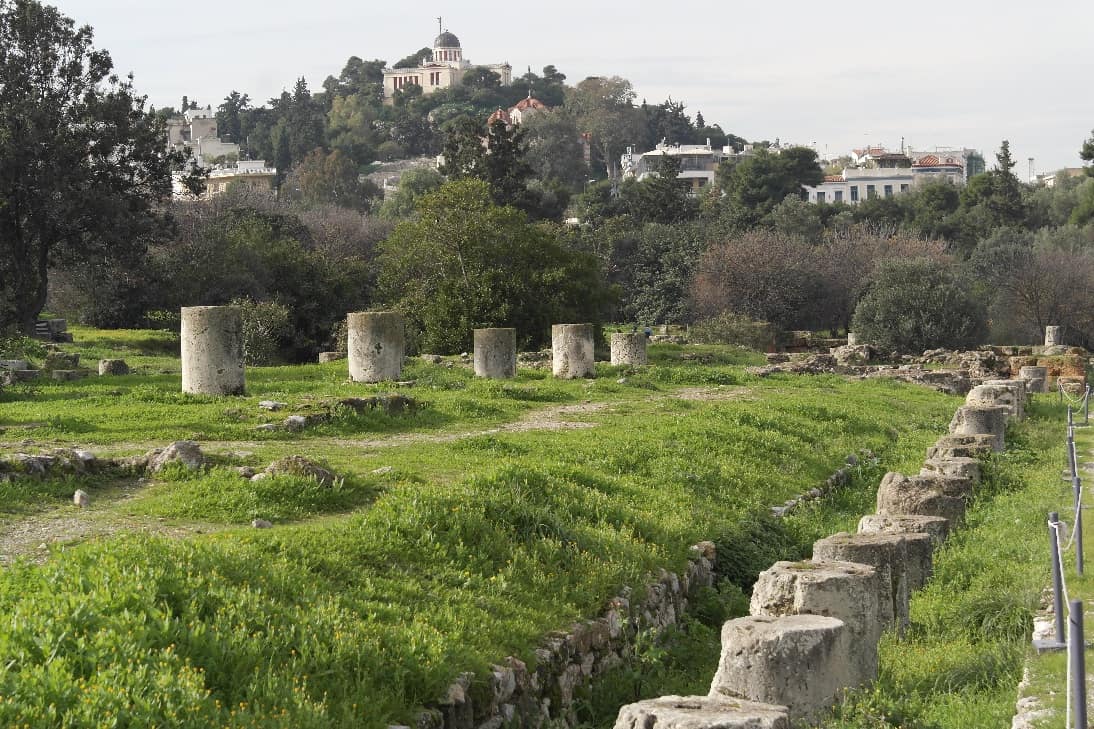
Ancient Agora
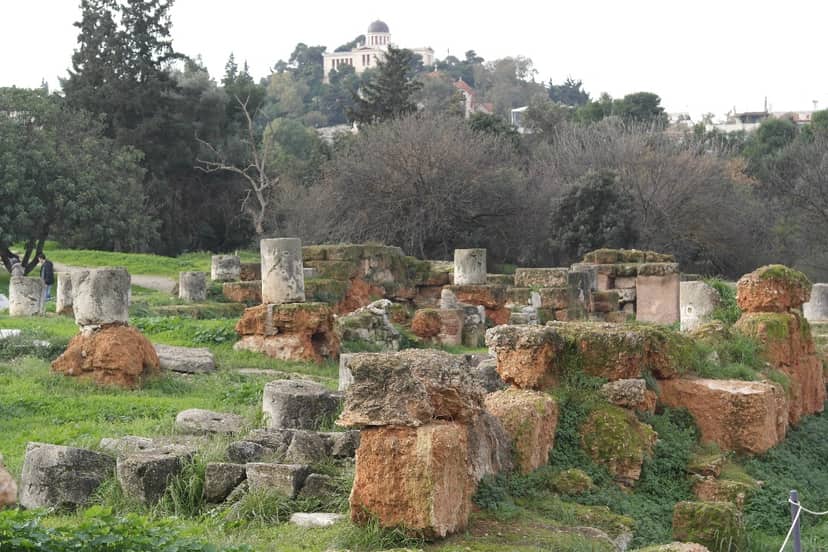
The sequence of the buildings of the Agora over time reflects the evolutionary course of the democratic polity during the five centuries of existence of the city-state. The first traces of human habitation in the wider area of the Agora date back to the Late Neolithic era (ca. 3000 B.C.) and consist of sherds of handmade pottery found in wells and pits. During the two following periods, the Late Hellenic or Mycenaean (1550-1100 B.C.) and the Iron Age (1,100-700 B.C.) a cemetery extends in the area, with vaulted and chambered tombs in the first, with cremations and burials in the second. At the same time, a small geometric settlement is developing. In the 6th century e.g. the state with extensive configurations transformed this space from private to public to host the city’s Agora.
The first public buildings, the Southeast Fountain and the Altar of the Twelve Gods, appeared in 520 B.C., during Pisistratus tyranny. With the change of the policy back to a democratic one, in 508/7 B.C. intense construction activity began in the Agora. First, the Old Bouleuterion for the new Bouleuterion and the Stoa Basileios, seat of the King Archon, were built. The two stone terms were also placed in its southwest corner to mark the sacred space. The sacking of the Agora by Persian troops in 480/479 B.C. turned many of its buildings into ruins. From the 2nd quarter of the 5th c. BC intense reconstruction was observed, which continued into the 4th c. B.C. and is directly linked to the prosperity of the Republic. Then the Painted Stoa, the Tholos, the New Bouleuterion, the Stoa of Zeus Eleutherios, the South Stoa I, the Mint, the Courts, the Temple of Hephaestus, the Temple of Apollo Patroos, the Southwest fountain, etc. were built.
The political decline of Athens brought about by the rise of Alexander the Great to the kingdom of Macedonia was followed by the cultural flourishing of the 2nd B.C. century. At this time, the Agora of Athens took on a new form with the construction of the three large Stoic buildings: the Middle Stoa, the South Stoa II and the Stoa of Attalos, a gift from the King of Pergamum Attalus II to the cradle of philosophy. A great blow to the buildings of the Agora was caused by their looting by Sulla’s troops in 86 BC, as a punishment because the Athenians sided with King Mithridates of Pontus and not with the Romans.
The sequence of the buildings of the Agora over time reflects the evolutionary course of the democratic polity during the five centuries of existence of the city-state. The first traces of human habitation in the wider area of the Agora date back to the Late Neolithic era (ca. 3000 B.C.) and consist of sherds of handmade pottery found in wells and pits. During the two following periods, the Late Hellenic or Mycenaean (1550-1100 B.C.) and the Iron Age (1,100-700 B.C.) a cemetery extends in the area, with vaulted and chambered tombs in the first, with cremations and burials in the second. At…
On the map
Experience Attica
Monastiraki Metro Station- Eridanos River
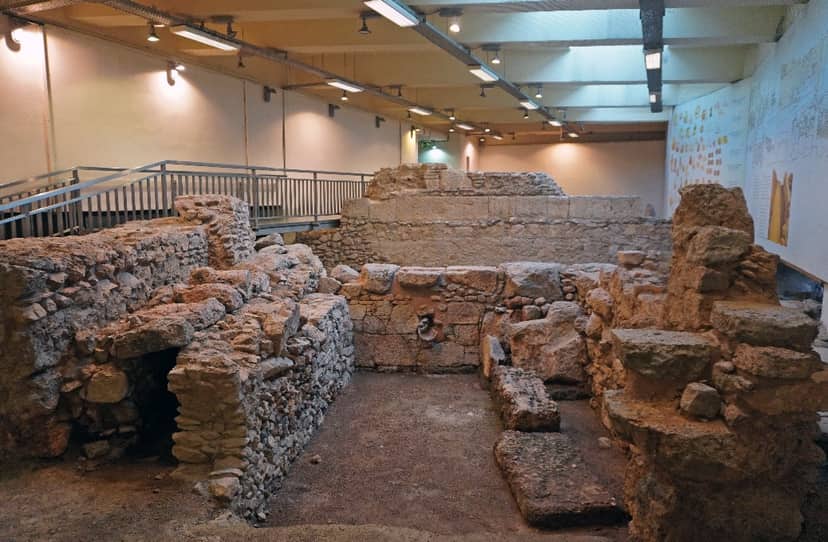
Monastiraki metro station is historical and one of the oldest on the Piraeus-Kifissia line. It was inaugurated on May 17, 1895…