

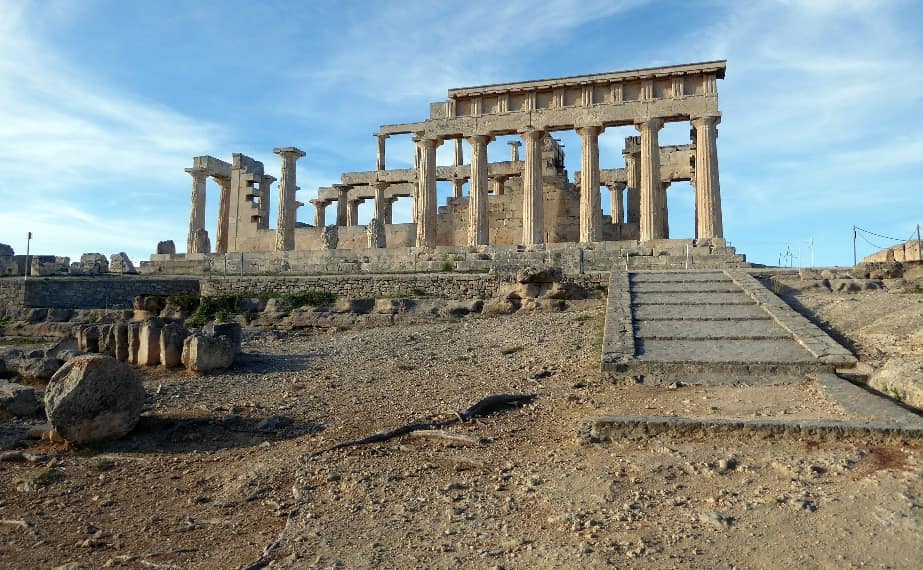
Temple of Athena Aphaia
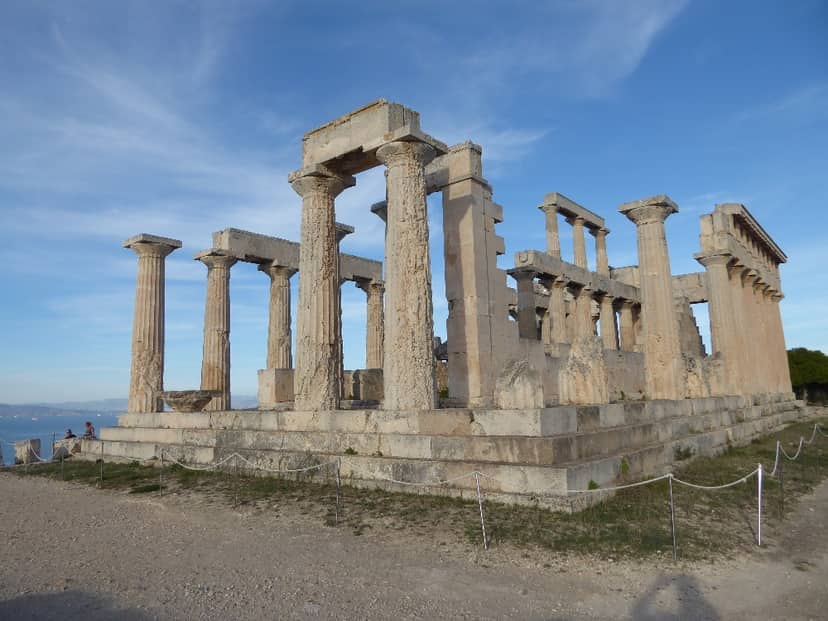
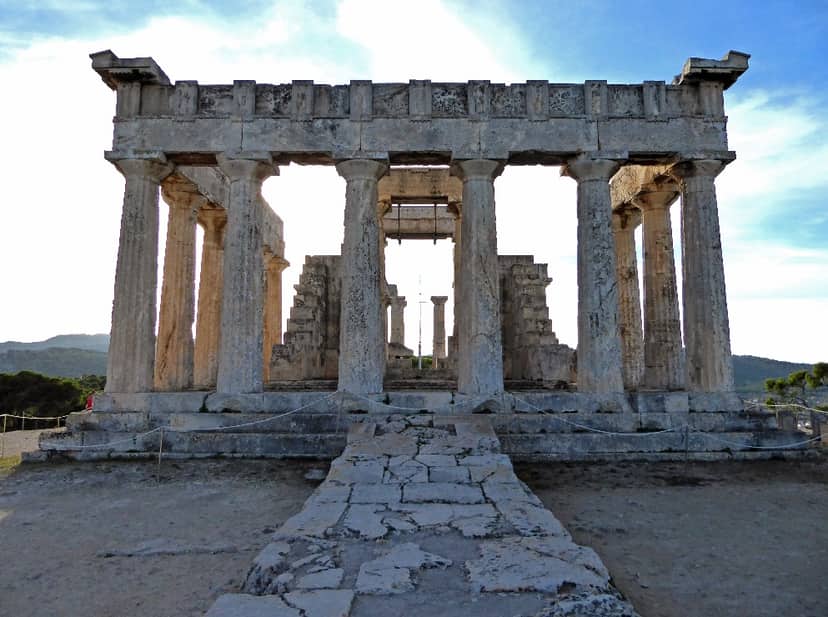
The temple of Athena Aphaia dominates a pine-clad hill in the north-eastern part of Aegina. It is the most important surviving monument of the sanctuary dedicated to the deity Aphaia, which seems to have been built on a site that was already cultic in Mycenaean times.
Pausanias mentions the myth of Aphaia and identifies her with the Cretan goddess Britomarti-Diktyna, a view now accepted by researchers. The temple was built around 500-490 BC and is the second temple of poros stone built in approximately the same position and orientation. The earliest Doric temple dates from around 570-560 BC and was destroyed by fire around 510 BC. At the time of the construction of the new temple, the sanctuary took on its definitive monumental configuration. A larger area was levelled, new retaining walls were built, the temenos was enclosed by a stone wall and the entrance was through an imposing propylaeum on the south side of the enclosure, while outside the propylaeum there was a complex of buildings for the needs of the sanctuary. The sanctuary of Aphaia was not preserved for a long time.
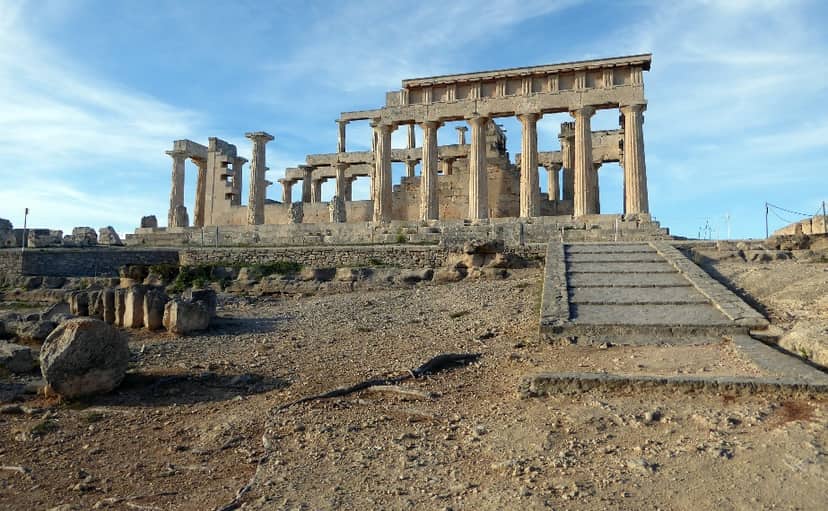
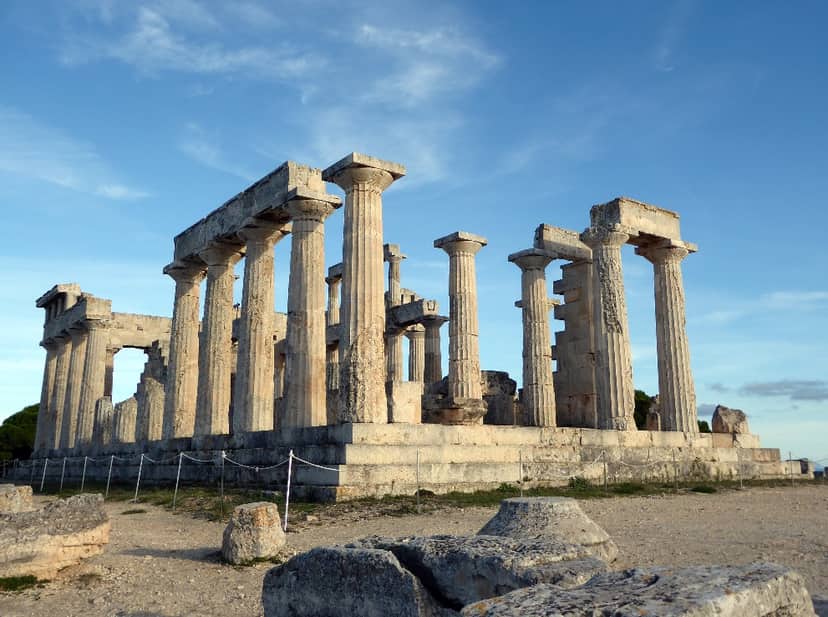
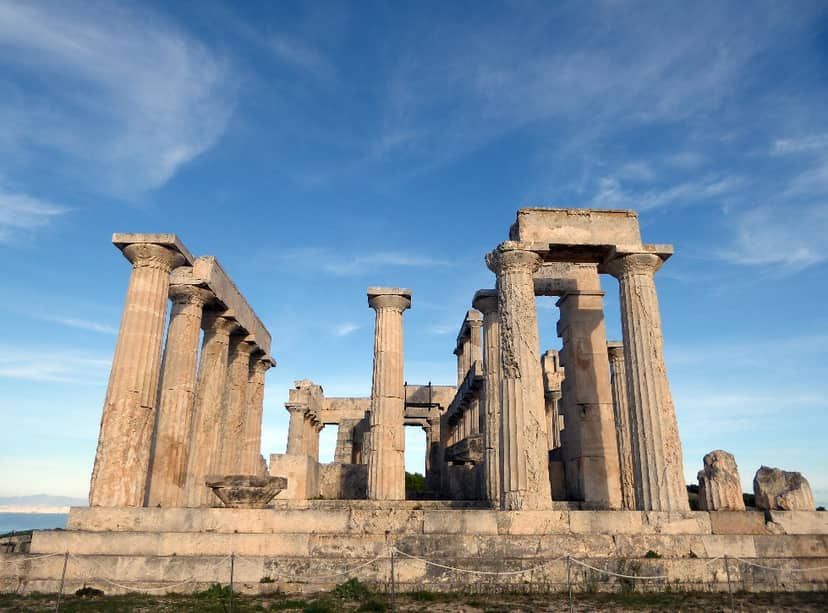
The imposition of Athens on Aegina from the middle of the 5th century BC also had its effects. Gradually the sanctuary fell into disrepair and only a few repairs were carried out in the 4th century BC. The 3rd century BC was a period of great decline and towards the end of the 2nd century BC the site was abandoned. The temple is a Doric peripteral temple with a colonnade of 12 columns on the long side and 6 on the short side. The columns are monolithic with 20 ribs, except for three on the north side, which are made up of drums. It rests on a three-stepped crepis, has a pronaos and an opisthodomos, each with two columns in antis, and a cella with an internal two-tier colonnade of five columns. The entrance was on the east side, where a sloping level of well-hewn stones was built. The columns, the walls of the cella and the entablature are made of local porous limestone and are covered with plaster, while some parts of the entablature have preserved painted decoration. The pitched roof of the temple was covered with Corinthian clay tiles, and only the first layer of tiles with the floral acrokeram was marble. The central floral acroterion, flanked by two korai, was also made of marble, as were the four sphinxes at the corners of the roof. The sculptures of the pediments and the acroteria of the roof were made of Parian marble and carried colors. Both pediments depict the mythical campaigns in Troy in which the heroes of Aegina distinguished themselves. The eastern pediment depicts the oldest battle of Hercules against Laomedon, king of Troy, in which Telamon, son of Aiacus, took part. The western pediment depicts the most recent campaign of Agamemnon against Priam, in which three of Aiacus’ descendants, Aias, Teukros and Achilles, took part.
In both campaigns, Athena is present as the central figure of each pediment. The western pediment recalls the aesthetics of the 6th century BC, while the eastern one, with its greater mobility of forms and lack of stylization, refers to the beginning of the 5th century BC. After its abandonment, the monument remained visible and impressive on the hill. It was first studied in 1811 by the architect Ch. R. Cockerell and his friend Baron von Hallerstein, who visited the site and excavated the pediment sculptures, which they took to Italy. From there they went to Munich in 1828, where they are still exhibited in the Sculpture Gallery.
A systematic excavation of the monument was carried out by the German Archaeological Institute in 1901 under the direction of Ad. Furtwangler and H. Thiersch and later, in 1964-1981, by D. Ohly. In 1956-1957 it was restored by A. Orlandos and E. Stikas.
The temple of Athena Aphaia dominates a pine-clad hill in the north-eastern part of Aegina. It is the most important surviving monument of the sanctuary dedicated to the deity Aphaia, which seems to have been built on a site that was already cultic in Mycenaean times. Pausanias mentions the myth of Aphaia and identifies her with the Cretan goddess Britomarti-Diktyna, a view now accepted by researchers. The temple was built around 500-490 BC and is the second temple of poros stone built in approximately the same position and orientation. The earliest Doric temple dates from around 570-560 B…
On the map
Experience Attica
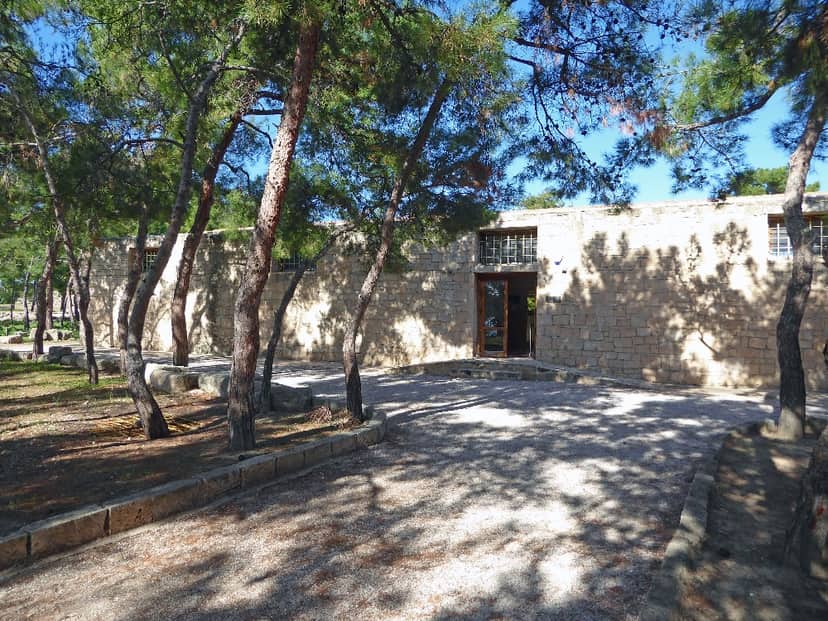
Archaeological Site and Museum of Kolona Aegina
The Archaeological Museum of Kolona Aegina was the first museum founded in the free Greek State, in 1829. Until 1982, it was…